When is the best time to surf Le Moule?
Peak Dec–Mar · often good Apr–May, Oct–Nov · can still fire Jun–Sep.
The core season runs roughly October through May, when North Atlantic swells and the trades push steady energy onto Grande-Terre's east coast — winter is the prime window, and Damencourt is the most consistent break on the islands, so even the fall and late-spring shoulder months produce plenty of surfable days. Summer rides trade windswell, and hurricane season (August–October) can deliver the biggest days of the year when a system passes at the right distance — brief, forecast-driven windows worth pouncing on. The water is warm year-round — boardshorts or a shorty at most.
What does a surf trip to Le Moule look like?
A typical trip from our guide. A real alert comes with the forecast for each day and a fare from your airport.
How much does a surf trip to Le Moule cost?
A five-night trip, per person, before food and rentals.
Rows marked "Google typical" are Google Flights' usual range for October, across all booking lead times, so a last-minute fare often lands above it. Checked Oct 24. Stays use our guide's nightly bands; transfers use the guide's quoted rates. Real alerts price the exact dates.
Where should you stay at Le Moule?
Closest to the wave
Cottage Familial Moulien (Gîtes de France) $
vacation rental · mid-range · Central Le Moule, walkable to L'Autre Bord beach
3-star self-catering gîte for up to four, centrally located on the Atlantic facade — kitchen, garden, AC, the kind of place that makes the town's Carrefour/Leader Price useful. Solid value base for a couple or small crew.
Stays nearbySurf camp
UCPA Surf House Le Moule $
surf camp · mid-range · Short drive to Damencourt; the camp runs sessions there and at Helleux and Le Souffleur
Purpose-built surf camp (opened recently) with air-conditioned dorms, a pool, equipped kitchen, chill zones and a family surf atmosphere — week-long packages bundle ~10 surf sessions, gear and a coach who reads the spots. The turnkey pick if you want structure and don't want to organize logistics. Based on the Le Moule/Morne-à-l'Eau side.
Stays nearbyCheaper
Frédo Surfcamp / Ride In (Morne-à-l'Eau side) $
surf camp · budget · Between Morne-à-l'Eau and Le Moule — drive to Damencourt
Hostel-style surf school and camp in the heart of Grande-Terre, with a teen/club-formula branch (Ride In). Budget, social, surf-first — you'll drive to the wave but the coaching and lift-sharing are built in.
Stays nearbyEvery place we researched, with its booking link, is under where to stay below.
What is the wave like at Le Moule?
Break type
Beach/Reef
Wave direction
Both
Best swell
NNE (N–ESE window)
Ideal size
3–8 ft
Best tide
Mid to high
Low: rock slabs just under the surface
Consistency
Consistent
Peak season
Dec–Mar
Nearest airport
PTP · ~16 mi
Drive from airport
25–35 minutes
What makes Le Moule unusual for the Caribbean is that it has real surf infrastructure — actual écoles de surf, a club scene, board rental and ding repair, French/EU services, and a town that hosts contests rather than just tolerating visitors. You're in France here: euros, French (and Creole), Carrefour and Leader Price for groceries, EU-standard roads and a 25-minute drive from an international airport. That convenience is the trade-off against bigger, emptier Caribbean breaks; Damencourt gets "more and more crowded" and the lineup fills with locals and lesson groups on the good days.
The town itself is unpolished and authentic rather than resort-pretty: a former sugar-era economic capital with the Damoiseau rhum agricole distillery in the cane fields, an Amerindian archaeology museum, and a long Atlantic beachfront. Base yourself in or right around Le Moule and you can walk or short-drive to the wave, eat well and cheaply, and use the spot as a launchpad for the rest of Grande-Terre — Saint-François, Pointe des Châteaux and the other east-coast reefs are all close. Come for a real surf town with EU comforts and a wave that rewards intermediates and up.
Who it suits
Intermediate-to-advanced surfers wanting a punchy, hollow reef break (Damencourt) with full surf-school and services backup; beginners and intermediates are well served by the adjacent L'Autre Bord beach break and the town's écoles de surf.
Where exactly is Le Moule?
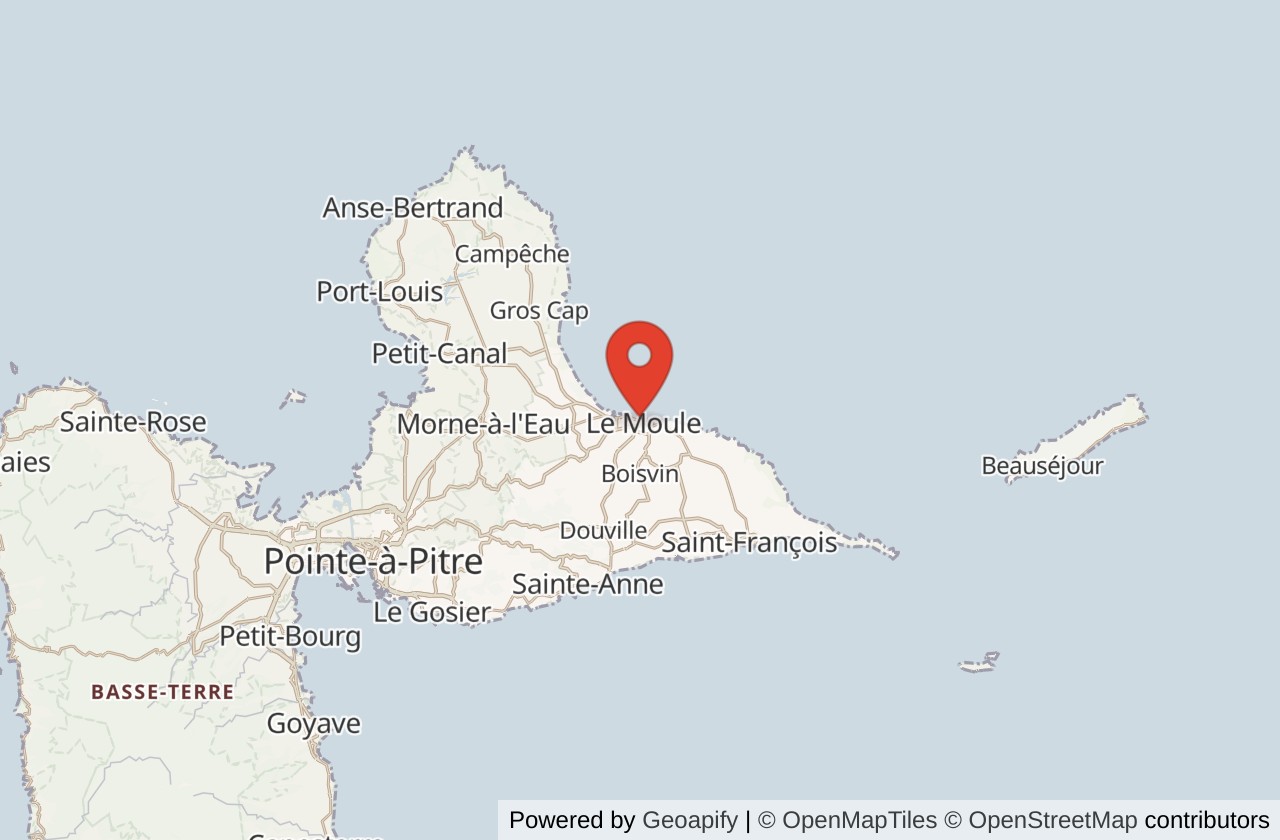
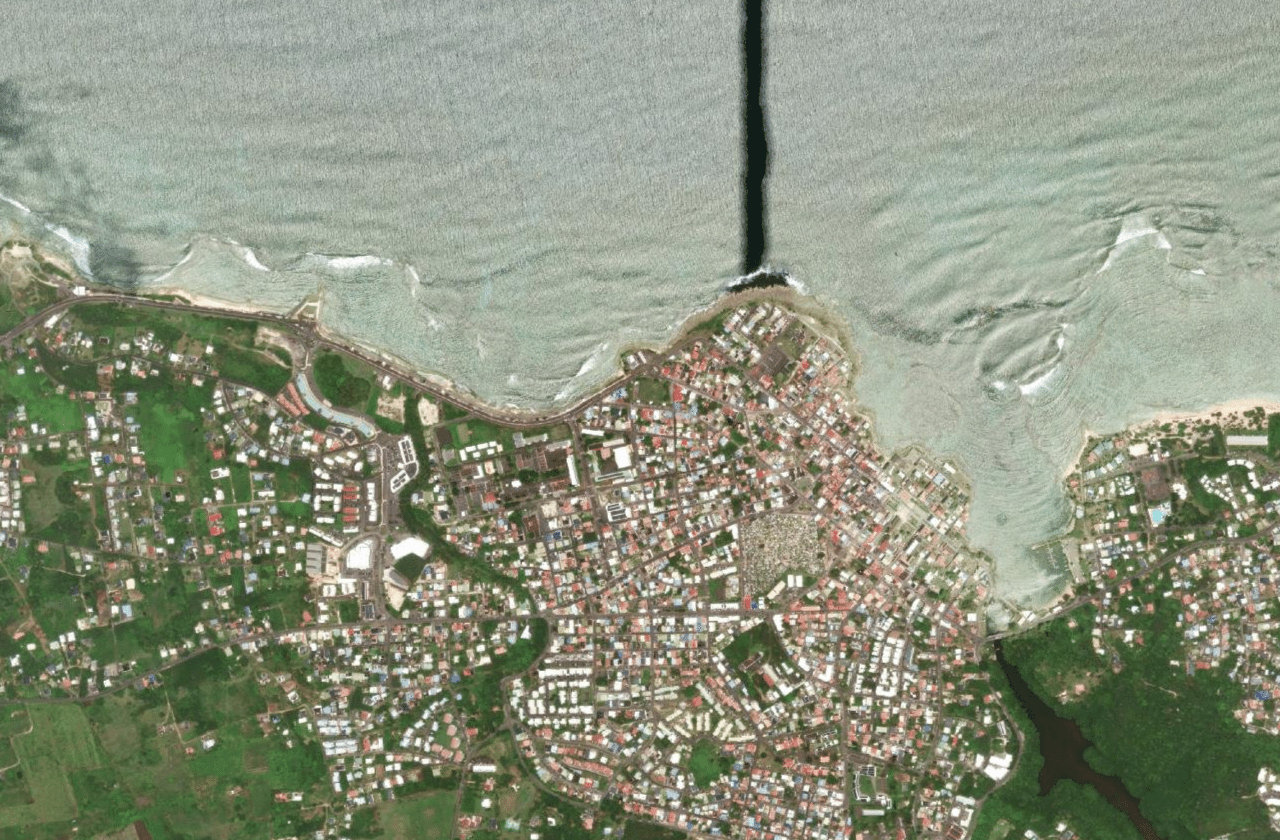
16.3333, -61.3500
What are the lineup and the town like at Le Moule?
Localism
moderate
Crowd
A mix of local rippers, surf-school groups and travelling surfers. Damencourt draws the experienced crowd and gets busy on the good days; L'Autre Bord beach is where the beginners and lesson groups spread out. Early mornings are quietest and usually cleanest before the trades and the crowd build. Weekends and holidays add beach crowds.
Damencourt is known as the island's premier reef, so the locals and the best surfers gather there — the consensus is that there's no aggressive localism, but the lineup is increasingly crowded and visitors are expected to keep a low profile, wait their turn and not drop in. Show respect at a reef where everyone knows everyone and you'll be fine; paddling straight to the peak and burning the pack is the way to sour it.
In the lineup: Damencourt is a reef with a right/left peak on the left side and a point on the right; the left reef gets barrelling over ~6ft and is for intermediate-to-advanced surfers, with entry and exit directly off the reef. It works best on N/NE swell with S/SE (offshore) wind, mid-to-high tide. Getting in and out is genuinely hard when the swell is big — time your entry off the rocks. Beginners and intermediates should default to L'Autre Bord's sandy beach break next door.
Le Moule is a real Creole working town, not a resort — a former sugar-era capital with the Damoiseau distillery in the cane fields, a Catholic church on the square, an archaeology museum and a long Atlantic beach. It's gritty and authentic, French in its services (euros, supermarkets, good roads) and Caribbean in its rhythm. Off the water it's about rum, food, the beach and using the town as a base for the wider east coast — quiet at night, lively at the lolos and the market by day.
How do you get to Le Moule?
Fly into Pointe-à-Pitre — Guadeloupe Pôle Caraïbes (Maryse Condé) International Airport (PTP) — about 16 miles from the break, 25–35 minutes. PTP is effectively the only airport for Guadeloupe — it handles all long-haul (Paris) and inter-island flights. There is no closer or alternative field worth considering for Le Moule.
- rental car€35–60/day · 25–35 minutes self-drive
By far the best option for surfers — Damencourt parking is a short hop and a car lets you chase swell to Helleux, Le Souffleur and the other east-coast spots. All the major agencies (Europcar, Hertz, Sixt, plus local outfits) have desks at PTP. Drive on the right; roads are EU-standard. Book a wagon or small SUV if you want roof bars for boards.
- taxi€40–70 per vehicle · 25–35 minutes
Official taxis wait outside arrivals; fares are metered/zoned and rise on Sundays and at night. Fine for a one-off transfer with a board bag (confirm the vehicle is an estate or van for boards over 7'0"), but you'll want wheels for the trip itself.
- private transfer€45–80 per vehicle · 25–35 minutes
Surf schools and surf camps around Le Moule (UCPA Surf House, Allamanda) will arrange airport pick-up — book ahead and flag board bags. Easiest hands-off option if you're not renting a car.
- bus€2–3 per person · 1–1.5 hours with connections
Guadeloupe's network réseau bus runs from the Pointe-à-Pitre hub to Le Moule, but service is slow, infrequent and not airport-direct — you'd taxi or bus into Pointe-à-Pitre first. Not realistic with boards or on a surf schedule.
Do you need a car at Le Moule?
Do you need a car?
recommended
Walkability
If you stay in central Le Moule or near L'Autre Bord, the beach break and town (restaurants, shops, ATMs) are walkable, and Damencourt is on the edge of town — a short walk or a couple of minutes' drive. Anything in the surrounding gîtes scattered through the cane country needs a car.
A rental car (€35–60/day) is the sensible default: it gets you to Damencourt, chases swell along the east coast, and reaches Damoiseau, the museum and Pointe des Châteaux on flat days. Guadeloupe has a public bus network but it's slow and not built for surf timing; there's no real Uber/rideshare culture, so taxis are pre-booked or grabbed at ranks. Scooter rental exists on the island but isn't an established Le Moule surf-transport norm.
Boards: Request roof bars when you book the rental, or bring soft racks and tie-downs — most agency cars are sedans/small SUVs. Damencourt and L'Autre Bord both have parking right by the water, so board-hauling on foot is minimal. Surf schools in town rent and store boards if you'd rather not fly with your quiver.
Where can you stay near Le Moule?
Surf camps and guided packages
Short drive to Damencourt; the camp runs sessions there and at Helleux and Le Souffleur · Purpose-built surf camp (opened recently) with air-conditioned dorms, a pool, equipped kitchen, chill zones and a family surf atmosphere — week-long packages bundle ~10 surf sessions, gear and a coach who reads the spots. The turnkey pick if you want structure and don't want to organize logistics. Based on the Le Moule/Morne-à-l'Eau side. (Direct (ucpa.com))
In Le Moule, close to the breaks · Long-running surf-camp set-up with bungalow lodging in Le Moule aimed squarely at travelling surfers — board storage, local spot knowledge and a social house vibe. Good middle-ground between a hostel and a hotel for a surf-focused trip. (Direct (surfcampguadeloupe.com))
Between Morne-à-l'Eau and Le Moule — drive to Damencourt · Hostel-style surf school and camp in the heart of Grande-Terre, with a teen/club-formula branch (Ride In). Budget, social, surf-first — you'll drive to the wave but the coaching and lift-sharing are built in. (Direct (guadeloupesurfcamp.com))
Hotels and other places to stay
Central Le Moule, walkable to L'Autre Bord beach · 3-star self-catering gîte for up to four, centrally located on the Atlantic facade — kitchen, garden, AC, the kind of place that makes the town's Carrefour/Leader Price useful. Solid value base for a couple or small crew. (Gîtes de France Guadeloupe (gitesdefrance-guadeloupe.com))
Varies — several sit 200m from the beach · Le Moule has a deep stock of independent gîtes and bungalows (roughly €33–150/night), many with pools, gardens and AC, some 200m from the sand. The budget-to-mid backbone of staying here — book via the aggregators or Gîtes de France and pick by distance to L'Autre Bord. (Gîtes de France, Airbnb, Lagon Travel, Cybevasion)
~20–25 min drive south down the east coast · If you want a marina town with more hotels, restaurants and nightlife than Le Moule offers, Saint-François is a short drive south and still close to the east-coast breaks and Pointe des Châteaux. A comfort upgrade at the cost of a daily commute to Damencourt. (Booking.com, direct)
Where do you eat at Le Moule?
- Le Spotrestaurant · $ mid-range
Creole plates with a view of the surfers — On-theme spot overlooking the break — French/Creole food and a terrace made for watching the lineup between sessions. Reviews are decent rather than spectacular, but the location is the draw for surfers.
- Le Paradis De La Merrestaurant · $ mid-range
Fresh seafood and Creole specialities — Well-reviewed (around 4.5) local seafood kitchen — a 'small gourmet getaway' at fair prices. A reliable sit-down dinner after a Damencourt session.
- La Case à Saveursrestaurant · $ mid-range
Creole plates and ti'punch / planteur — Repeatedly called one of the best on the island for the price, with locals praising the rum punches. Authentic Creole cooking, good value.
- Pizza Bellarestaurant · $ budget
Wood-style pizza — Highest-rated eatery in town (around 4.7) and a cheap, easy refuel — pizza is weirdly beloved across Guadeloupe and this is the local favourite. Good for a fast, affordable post-surf feed.
- Kreol Barcafe · $ budget
Homemade dishes from local, seasonal produce — Casual café-bar doing homemade plates with local and seasonal ingredients — a relaxed lunch or coffee stop in town.
- La Tonnellerestaurant · $ budget
Budget Creole lunch — Budget-friendly local lunch spot — the kind of place to grab a cheap, generous midday plate without ceremony.
- Beach lolos & food trucks (L'Autre Bord)street food · $ budget
Grilled chicken, accras, bokit and cold Carib beer — Like the rest of Guadeloupe, Le Moule's beachfront has casual lolos and trucks doing bokit (the fried-bread sandwich), accras de morue, grilled chicken and rum punch — the cheapest, most local way to eat between surfs. Cash is handy and hours follow the beach crowd.
Cooking for yourself
- Carrefour Market Le Moulesupermarket
Full supermarket at Ccal Baie Side (La Baie), open Mon–Sat ~8am–8pm and Sunday morning. Stocks local and imported groceries, fresh produce, drinks and self-catering basics — everything you need for a gîte stay, at French mainland-style ranges (Caribbean import prices).
- Leader Price Le Moulesupermarket
Budget supermarket in town, open daily ~8:30am–8pm. Cheaper everyday lines and a handy fallback for water, snacks, beer and basics close to the beach.
- Le Moule market & roadside stallsfarmers market
The town has a local market and roadside vendors for tropical fruit, vegetables, spices and fresh fish — the spot for produce and a taste of Creole ingredients to cook yourself. Best in the mornings; bring cash.
Where do you rent or fix a board?
- Madras Surf Schoollessons · board rental · ding repair · fins · €20–35/day (typical Guadeloupe rates)
Widely rated the best surf school in Le Moule / Guadeloupe — coaching from beginner to intermediate/expert, reef and competition sessions, fin and nose repairs, and an instructor (JP) known for reading the conditions and moving groups to the best spot of the day. Board rental available. Cash and card; book ahead in season.
- Frédo Surfcamp / Ride Inlessons · board rental · €20–35/day
Surf school and camp between Morne-à-l'Eau and Le Moule offering lessons, club formulas and rentals — a second established option if Madras is booked, and the one tied to teen/group programmes.
- Local écoles de surf (Le Moule)lessons · board rental · wax · €20–35/day
As an official 'Surf City', Le Moule has several independent instructors and small écoles working the L'Autre Bord beach and Damencourt — board rental, lessons and basics. There's no big-box surf retail shop in town, so for specific hardware (a particular board, a quiver of fins, a wetsuit) plan to bring it or shop in Pointe-à-Pitre. Bring your own wax and ding kit to be safe.
What do you do when it's flat?
- Distillerie Damoiseaufood drink · free–€10 (tour & tasting)
Guadeloupe's best-known rhum agricole distillery, surrounded by cane fields just outside Le Moule. Guided tour of the cane-juice rum-making process with a tasting and bottle sales — the essential flat-day or rest-day outing here.
- Edgar Clerc Archaeological Museumculture · free–low
Small museum dedicated to the island's Amerindian / pre-Columbian cultures — decorated pottery, carved ornaments and polished axes, plus rotating exhibitions. A genuinely interesting hour on a rainy or flat morning.
- Plage de L'Autre Bordnature · free
Le Moule's town beach and the spot's beginner break — sandy, walkable from the centre, good for swimming, longboarding and learning when Damencourt is too heavy. The everyday beach hub.
- Pointe des Châteauxnature · free
Dramatic limestone headland at the easternmost tip of Grande-Terre, ~30–40 min south via Saint-François — a short hike to a cross with big Atlantic views. The classic east-coast day trip.
- Le Moule waterfront & town walkculture · free
Wander the former sugar-capital town: Saint-Jean-Baptiste church, colonial-era houses, the harbour and the long beachfront. Real, lived-in Creole Guadeloupe rather than resort polish.
- Diving & east-coast beacheswater · €50–80 per dive
The Grande-Terre coast around Saint-François has dive operators and a string of beaches (Plage des Raisins Clairs, the marina) within easy reach for non-surf days. Book dives through Saint-François centres.
What should you know before you go?
Cash & ATMs
Le Moule is a proper town, so there are bank branches and ATMs (distributeurs) in the centre — Crédit Agricole and other French banks operate on the island. Euros are the currency and cards are widely accepted in supermarkets and most restaurants; carry some cash for lolos, beach trucks and the market. No cash-machine drama like remote spots — withdraw in town.
Medical
Le Moule has pharmacies and GP/medical services in town. The main hospital, CHU de la Guadeloupe, is at Les Abymes near Pointe-à-Pitre, roughly 25–35 minutes away — full EU-standard emergency care. As an EU/French territory, the European EHIC card applies for EU visitors; others should carry travel insurance.
Water safety
Damencourt is a sharp coral reef — booties are wise, and sea urchins are the main everyday hazard, so watch your hands and feet on entry and exit. Getting in and out off the reef is difficult and dangerous when the swell is big; pick your moment and don't take a heavy day beyond your level. Strong Atlantic exposure means real power and current on bigger swells. L'Autre Bord's sandy beach is far more forgiving. There are no permanent lifeguards on the surf breaks — treat it as a self-reliant lineup. Water quality is generally good.
Guadeloupe basics: money, entry, phones, water
Currency
Euro (EUR) — ~1.08–1.10 USD per EUR (mid-2026)
Entry (US passport)
Up to 90 days in any 180-day period — Guadeloupe is a French overseas department (DROM) and part of the EU, but it is NOT in the Schengen area — so a French/Schengen short-stay visa does not cover it, and the EES/ETIAS system does not apply here. Visa-exempt Americans get the standard 90-days-in-180 short stay. Carry proof of return/onward travel and accommodation; these can be checked on arrival.
Language
French, Antillean Creole (Guadeloupean Kreyòl, widely spoken alongside French). Modest. This is France, not a tourist-English Caribbean island — staff at bigger hotels, dive/surf operators and the airport handle English fine, but in village boulangeries, small restaurants, markets and on the beach you'll get much further with basic French. A few phrases and a translation app go a long way; locals are warm when you try.
Plugs
C, E · 230V / 50Hz (European standard — US/Canada 120V gear needs a plug adapter and must be dual-voltage; most phone/laptop chargers are)
Tipping
Service is included by law ('service compris'): restaurant and hotel bills already fold in service, so tipping is not expected. Rounding up or leaving a euro or two for good table service is a nice gesture, not an obligation. Taxi drivers don't expect a tip; round up if they helped with bags. Tip a surf instructor or boat skipper a few euros only if they went out of their way — it's optional here, French-style.
Phone / data
Orange Caraïbe, SFR Caraïbe, Digicel, Travel eSIM (Airalo, Holafly, etc.). Coverage is good across the populated arc — Grande-Terre's south coast (Le Gosier, Sainte-Anne, Saint-François) and around Basse-Terre town — but thins out on the wild, mountainous west (Côte sous le Vent / leeward Basse-Terre), inside the Parc National rainforest, and on the outer islands. If you hold an EU SIM, 'roam like at home' applies and you can use it here at no extra cost — but confirm the French West Indies are in your plan's roaming zone, as a few budget EU operators carve out the overseas departments. Download offline maps before chasing the more remote north-Grande-Terre and leeward-coast breaks.
Tap water
Tap water is treated to French/EU standards and is generally safe to drink across the island. The real-world catch is supply, not contamination: Guadeloupe's aging distribution network suffers frequent water cuts ('tours d'eau') and pressure outages, and quality can dip locally after heavy rain or storms — so many residents and visitors keep bottled water on hand as a backstop. If your stomach is sensitive, bottled is cheap insurance, especially in the outer islands.
Emergency
112 is the EU-wide emergency number and works from any phone. You can also dial the French services directly: 15 for SAMU/medical, 17 for police (gendarmerie), 18 for fire, and 196 for sea/coast-guard rescue.
Other passports: entry rules differ — check the official source before booking.
Alert me when Le Moule is on
Drop your email and you'll get one message when our forecast shows a trip-worthy window here: the dates, the size, and a place to stay. Free.
Frequently asked questions about Le Moule
Where is the best surf in Guadeloupe?
Le Moule, on the Atlantic east coast of Grande-Terre, is widely considered the capital of Guadeloupe surfing — it was even given an official 'Surf City' label in 2023. Its reef break Damencourt is the most consistent wave on the islands, with a gentler beach break at L'Autre Bord next door for beginners.
How do you get to Le Moule from the airport?
Fly into Pointe-à-Pitre (PTP), Guadeloupe's main international airport, then it's a 25–35 minute drive (about 16 miles) to Le Moule. A rental car is the best choice for surfers; taxis and pre-booked transfers also run the route.
Is Damencourt a beginner surf spot?
No — Damencourt is a coral reef break for intermediate to advanced surfers, with a fast, hollow wall that barrels over about six foot and a tricky entry/exit off the reef. Beginners and improvers should surf the adjacent L'Autre Bord beach break or take a lesson with one of Le Moule's surf schools.
When is the best time to surf Le Moule?
October to May is the season, with winter the most consistent window as North Atlantic swells and the trades hit Grande-Terre's east coast. Damencourt works best on N/NE swell with offshore S/SE wind. The water is warm year-round, so you'll surf in boardshorts or a shorty.
Are there surf schools in Le Moule?
Yes — Le Moule is an official 'Surf City' with real surf infrastructure. Madras Surf School is the best-known, offering lessons from beginner to expert, board rental and ding repair; Frédo Surfcamp/Ride In and several independent écoles de surf also operate around L'Autre Bord and Damencourt.
Do I need a car in Le Moule?
A rental car is recommended (around €35–60/day from PTP). The breaks have parking right by the water, and a car lets you chase swell to Helleux, Le Souffleur and the rest of the east coast and reach the Damoiseau distillery and Pointe des Châteaux. Public buses exist but are slow and not built for surf timing.
Is Le Moule expensive?
Guadeloupe is part of France and uses the euro, so it's pricier than much of the Caribbean for groceries and dining (import costs), but gîtes start around €33/night, local lolos and food trucks are cheap, and supermarkets like Carrefour and Leader Price make self-catering easy.
What is there to do in Le Moule besides surf?
Tour the Damoiseau rhum agricole distillery, visit the Edgar Clerc archaeology museum, relax at L'Autre Bord beach, and day-trip to Pointe des Châteaux on the easternmost tip of Grande-Terre. Saint-François, with its marina and dive operators, is a short drive south.
Sources for this guide
- wannasurf.comsecondary source · Le Moule wave type (left reef-coral, fast hollow wall), swell/wind/tide, skill level, urchin hazard, entry/exit difficulty, crowd
- en.guadeloupe-tourisme.comofficial · Damencourt break specifics (reef, right/left peak + point, barrels over 6ft, intermediate-advanced), official tourism description
- lesilesdeguadeloupe.comofficial · Le Moule as most consistent island spot, 'Surf City' label 2023, best season Oct–May, L'Autre Bord beginner beach break
- tripadvisor.comsecondary source · Le Moule restaurants and ratings (Pizza Bella, Le Paradis De La Mer, La Case à Saveurs, Le Spot, Kreol Bar, La Tonnelle)
- tripadvisor.comsecondary source · Madras Surf School live listing, reputation, lessons/reef coaching/fin & nose repair, instructor JP, location near Damencourt
- ucpa.comofficial · UCPA Surf House Le Moule: dorms, pool, kitchen, week packages with ~10 sessions, spots Helleux/Le Souffleur/Damencourt, ~16.6km from airport
- en.surfcampguadeloupe.comofficial · Allamanda Surf Camp bungalow lodging in Le Moule
- guadeloupesurfcamp.comofficial · Frédo Surfcamp / Ride In surf school and camp between Morne-à-l'Eau and Le Moule, club/teen formulas
- rome2rio.comsecondary source · PTP to Le Moule transfer options, ~15 mi road distance, ~25 min drive, bus existence
- pagesjaunes.frsecondary source · Carrefour Market Le Moule (Ccal Baie Side) location and opening hours
- alternativi.frsecondary source · Leader Price Le Moule location and opening hours
- en.guadeloupe-tourisme.comofficial · Distillerie Damoiseau tour and tasting, cane-juice rum, location in cane fields by Le Moule
- en.guadeloupe-tourisme.comofficial · Edgar Clerc Archaeological Museum (Amerindian/pre-Columbian collection) in Le Moule
- gitesdefrance-guadeloupe.comsecondary source · Cottage Familial Moulien gîte (3-star, central Le Moule, sleeps 4) and Gîtes de France inventory / price range
Guide researched and verified 2026-06-12. Details change; confirm bookings and entry requirements before travel.