When is the best time to surf Dominical?
Peak Jun–Sep · often good Oct–May.
The biggest, most powerful surf lands in the green season, roughly May through November, with the heaviest south swells peaking June to September — bigger, hollower and more for experienced surfers. The dry season (December–April) brings smaller, cleaner, well-organized waves, steady morning offshores and blue sky, which is the friendlier window for improvers and the busier tourist season. The wave works on most tides but the banks tend to be best from mid to high; water is warm year-round, boardshorts and a rash guard only.
What does a surf trip to Dominical look like?
A typical trip from our guide. A real alert comes with the forecast for each day and a fare from your airport.
A real alert we sent · Aug 31
We matched a surfer flying from Orlando (MCO) to this window: Sep 4–6, 3 good days with faces up to 7 ft, peaking 7/10. 4 nights, flights from $535 round trip.
This is a prior real trip from our match log, not a forecast. Windows and fares change; your alert carries the current ones.
How much does a surf trip to Dominical cost?
A five-night trip, per person, before food and rentals.
Rows marked "based on … alerts" are the middle half of the real round-trip fares we quoted in alerts on that route, priced 3 to 10 days before departure, since June 2026. Rows marked "Google typical" are Google Flights' usual range for September, across all booking lead times, so a last-minute fare often lands above it. Checked Oct 17. Stays use our guide's nightly bands; transfers use the guide's quoted rates. Real alerts price the exact dates.
Where should you stay at Dominical?
Closest to the wave
Cabinas San Clemente $
guesthouse · mid-range · Beachfront in the village
Veteran beachfront cabinas attached to the Tortilla Flats bar-restaurant, right on the sand in the middle of town — about as central and surf-convenient as it gets here.
Stays nearbyCheaper
Cool Vibes Beach Hostel $
hostel · budget · Steps from the beach in the village core
The default backpacker base: dorms and private rooms a short walk from the sand, a social surfer crowd, and on-site board rentals and lessons. Books out in dry season — reserve ahead.
Check ratesEvery place we researched, with its booking link, is under where to stay below.
What is the wave like at Dominical?
Break type
Beach
Wave direction
Both
Best swell
S (ESE–WSW window)
Ideal size
3–8 ft
Best tide
Mid to high
Low: hollower but closes out
Consistency
Very Consistent
Peak season
Jun–Sep
Nearest airport
SJO · ~119 mi
Drive from airport
3–3.5 hours
The town itself is a small, scruffy, barefoot surf village that has somehow kept its happy-hippie soul while the rest of the Costa Ballena coast gentrifies around it. A handful of dirt-and-gravel streets run back from the beach, lined with sodas, surf schools, a craft brewery, yoga studios and fruit stands, and the whole place still operates on tide times rather than clock time. There is no big resort strip and no nightlife machine — people come here to surf hard, eat well and disappear into the jungle on flat afternoons.
Know what you're walking into. The main beach is not a learner's wave: it carries serious rip currents — some of the strongest in Costa Rica — and drownings happen here, mostly to swimmers and beginners who underestimate it. Surf schools run beginners up the coast to gentler, more forgiving sandbanks at Dominicalito and Playa Hermosa, and bring them back to the main peak only when they've earned it. Come with an honest read on your own ability, a car or a shuttle plan for the 3-hour run down from San José, and a few flat-day waterfalls on your list, and Dominical delivers about as pure a Pacific surf-and-jungle trip as the country has left.
Who it suits
Intermediate to advanced surfers who want a powerful, consistent beach break with barrels — and beginners willing to learn at the gentler nearby banks (Dominicalito, Playa Hermosa) under a school rather than charging the main peak.
Where exactly is Dominical?
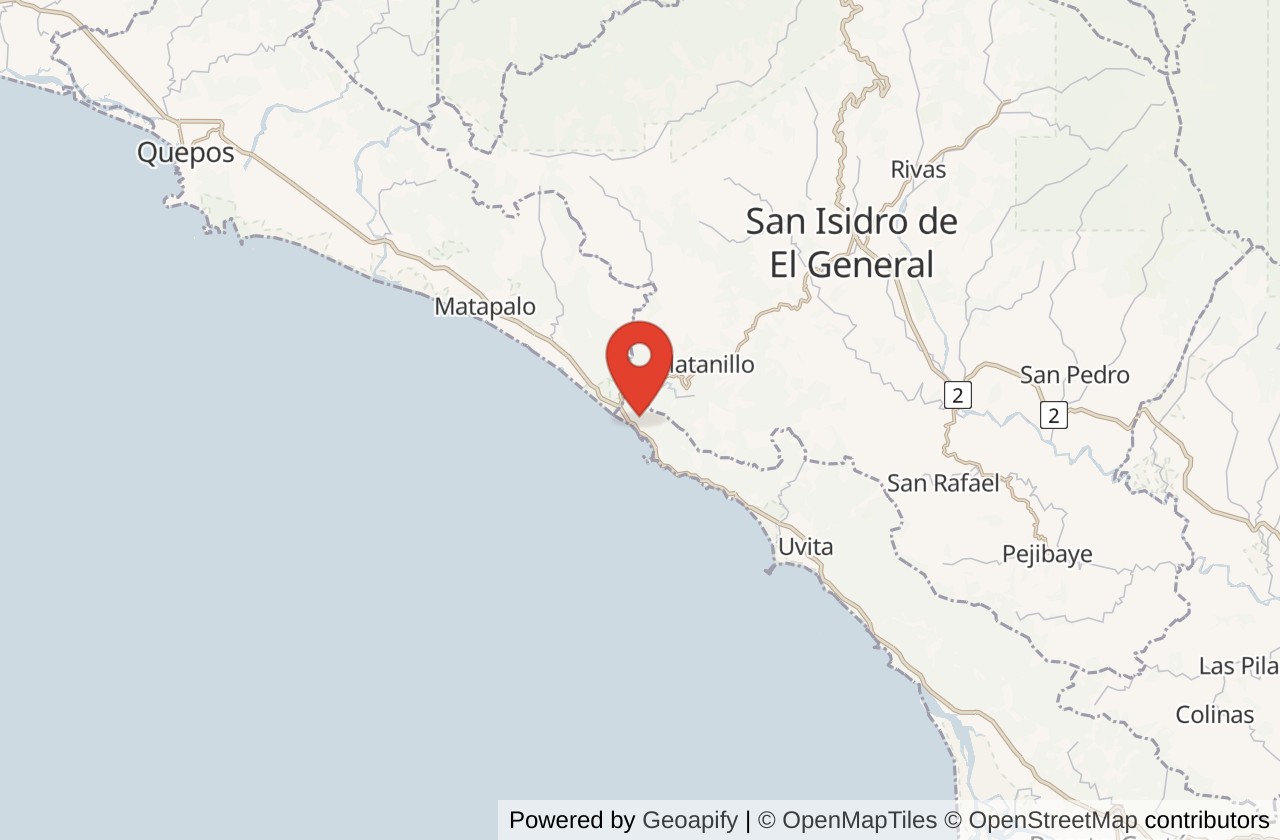
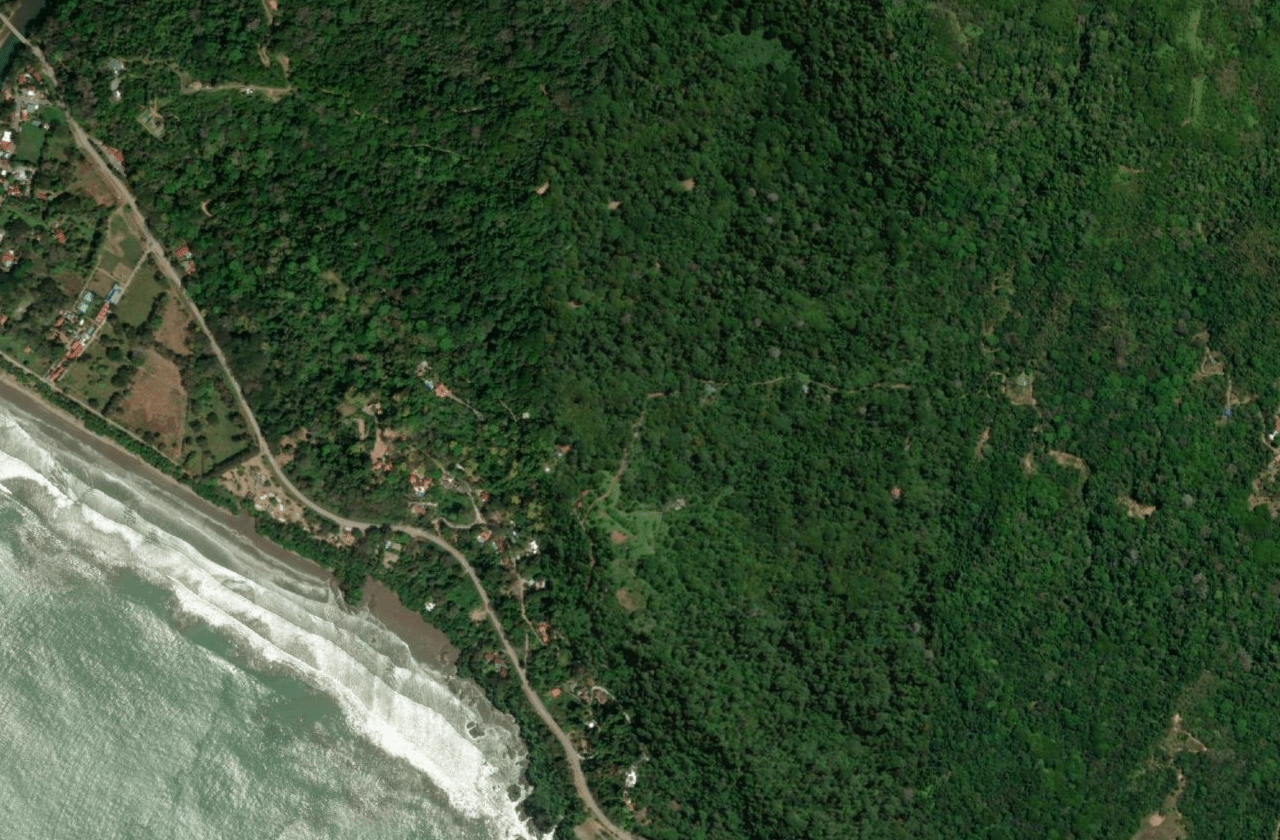
9.2500, -83.8500
What are the lineup and the town like at Dominical?
Localism
mellow
Crowd
A mix of traveling surfers, expats, surf-school students and a core of locals — busiest in the December–April dry season and around holidays, quieter and bigger in the green season. The beach break has multiple peaks so it rarely feels like a brawl; dawn is cleanest and least crowded, and the lineup thins fast in the heat of the afternoon.
Dominical is known as a friendly, low-localism lineup — the long beach break spreads people out and there's plenty of swell to go around, so it stays relaxed compared with Costa Rica's pointbreaks. Standard beach-break manners apply: don't drop in, don't paddle straight to the best bank and snake the peak, and give the local crew and the surf-school groups their space. Respect goes a long way in a small town where you'll see the same faces all week.
In the lineup: Sandbars shift with the seasons, but the best banks are usually just south of the Río Barú mouth. Pick a peak, watch where the rip is running and use it to paddle out rather than fight it, and don't sit too close to the rivermouth on a big day. The wave breaks fast and close to shore with real power — it's a beach break that punishes hesitation. Beginners should not paddle out at the main peak; go with a school to the gentler banks.
Dominical has kept the barefoot, slightly ramshackle surf-village feel that much of Costa Rica has lost: dirt side streets, dogs and chickens, fruit stands, yoga studios, a craft brewery and tour-tout signs, all backed by steep green jungle. It's bohemian and a little rough around the edges, leans wellness-and-reggae, and runs on island time. Off the water it's about waterfalls, sunsets, a cold beer at Tortilla Flats and not much of a clock — a deliberate contrast to the polished resort towns up the coast.
How do you get to Dominical?
Fly into Juan Santamaría International Airport, San José (SJO) — about 119 miles from the break, 3–3.5 hours. SANSA and Sansa-partner regional flights serve Quepos (XQP, ~45 min north by road) from San José, cutting the long drive but adding a connection and a hard board-bag limit on small turboprops. Palmar Sur (PMZ) to the south is another regional strip but rarely useful for visitors. For most surfers SJO plus a drive or shuttle is the move.
- rental car$45–75/day plus mandatory insurance · 3–3.5 hours self-drive
The most flexible option — you'll want wheels for flat-day waterfalls and the gentler beginner banks up the coast. Route is the autopista (Ruta 27) to the coast at Jacó, then the Costanera Sur (Ruta 34) south. Roads are paved and easy; a small SUV is plenty. Request roof racks ahead for board bags or bring soft racks. Avoid the last stretch after dark on your first run.
- shuttle$55–80 per person (shared) / $250–350 per van (private) · ~4 hours door to door
Shared and private shuttles run daily between SJO and Dominical with operators like Easy Ride and Monkey Ride; they pick up just outside arrivals and drop at your lodging. Shared vans switch vehicles in Quepos on some routings. Confirm board bags when booking — most take them but space on shared vans is limited.
- bus$14–18 per person · ~6–7 hours incl. transfer
Cheapest option: a TRACOPA coach from San José down the Costanera. Slower and a hassle with boards (luggage bay space is not guaranteed), but it works for budget travelers with one shortboard in a low-profile bag. Confirm the Dominical stop when buying — some services terminate in Uvita.
- private transfer$200–320 per vehicle · 3–3.5 hours
A pre-booked private driver is the easiest door-to-door option with a quiver of boards. Most hotels and surf camps will arrange one; agree the price and confirm the vehicle takes board bags before you book.
Do you need a car at Dominical?
Do you need a car?
recommended
Walkability
The village core is tiny and entirely walkable — beach, surf schools, sodas, the brewery and shops are all within a few flat minutes of each other and most in-town lodging is a 2–10 minute walk to the sand. You only need wheels for the beginner banks up the coast, the waterfalls, and lodging up in the Escaleras hills above town.
A rental car ($45–75/day plus insurance) makes the trip easiest and unlocks Nauyaca Falls, Uvita and the quieter beginner breaks. Without one you can manage: shared shuttles connect the coastal towns, local buses run the Costanera to Uvita and Quepos, and informal taxis hang around the village. There is no Uber down here to speak of — your lodging will have a trusted driver's number. Scooter and ATV rentals exist but the highway traffic and rain make a car the saner choice for most.
Boards: Surf schools and shops in town rent boards by the day, so many travelers skip the board-bag hassle entirely. If you bring your own, rental cars can be fitted with racks (request ahead) or use soft racks; taxis and shuttle vans will take boards but confirm in advance, especially for longer guns and multi-board bags.
Where can you stay near Dominical?
Steps from the beach in the village core · The default backpacker base: dorms and private rooms a short walk from the sand, a social surfer crowd, and on-site board rentals and lessons. Books out in dry season — reserve ahead. (Hostelworld, Booking.com, direct)
Short walk to the beach · Clean, budget-friendly rooms in lush gardens a few minutes from the break — a reliable, no-frills pick for surfers who want a private room without paying boutique prices. (Booking.com, direct)
Across from the Playa Dominical beach area · Mid-range rooms with a pool, restaurant and bar right by the beach end of the village — convenient for dawn patrols and close to the surf schools. (Booking.com, direct)
Walking distance, near the beach · Long-running budget spot with camping, dorms and basic privates plus a shared kitchen — the cheapest way to stay walking-distance from the main peak. (Hostelworld, direct)
Beachfront in the village · Veteran beachfront cabinas attached to the Tortilla Flats bar-restaurant, right on the sand in the middle of town — about as central and surf-convenient as it gets here. (Direct, Booking.com)
~2 km south at Dominicalito — 5 min drive · Smarter ocean-view rooms on the rocks at Dominicalito, the sheltered cove just south where the gentler beginner waves break. A quieter, more scenic base a short hop from the main town. (Booking.com, direct)
Up in the Escaleras hills — 10–20 min drive down to the break · The hills above Dominical hold a cluster of view villas and small lodges with pools and jungle outlooks, bookable on Airbnb and Vrbo. The pick for groups or families splitting costs who don't mind driving to the wave; a car is essential up here. (Airbnb, Vrbo, direct)
Where do you eat at Dominical?
- Tortilla Flatsrestaurant · $ mid-range
Fresh fish tacos and the calamari with tropical sauce, Imperial in hand — The beachfront institution and the social heart of the village — surfers wander in straight off the sand, reggae plays, and it runs breakfast through dinner. Not the cheapest plate in town but the most reliable and the best people-watching.
- Fuego Brew Co.bar · $ mid-range
House-brewed craft beer with a jungle-canyon view from the upper deck — Dominical's own brewery, on the main road by the Danyasa yoga retreat — a striking multi-level space over a forested gully, with a solid food menu to go with the beers. The go-to for a post-surf pint and dinner.
- Soda Nanyoasoda · $ budget
Casado with fresh-caught fish; full plate, local price — A genuine Tico soda on the main drag near the soccer field, doing casados, gallo pinto and fresh seafood at the cheapest prices in town. Where to eat when you want to fill up without spending tourist money.
- Mama Toucan's Café & Natural Marketcafe · $ mid-range
Smoothie bowls, good coffee and vegetarian-friendly lunches — Attached to the organic market at the entrance to town — the spot for a healthy breakfast, espresso and post-surf smoothie, with plenty of vegan and gluten-free options for the wellness crowd.
- Por Qué No (Costa Paraiso)restaurant · $$ high-end
Sunset dinner with fresh seafood over the rocks at Dominicalito — The romantic-dinner option, on the cliff at Costa Paraiso just south of town — ocean-view tables, a more refined menu and the best sunset seat in the area. Worth the short drive for a nicer night out.
- Phat Noodlefood truck · $ budget
Thai-style noodles and curries from the food-truck pod — Part of Dominical's casual food-truck and street-food scene — quick, cheap, tasty Asian plates that make a good change from rice-and-beans. Hours can be seasonal, so check it's open.
Cooking for yourself
- BM Supermarketsupermarket
The largest store in town, on the Costanera highway, with the widest selection of local and imported groceries — the place to do a real shop for a self-catering stay. There's an ATM just inside the entrance.
- Super Dominicalminimart
Smaller grocery in the plaza across the highway that nonetheless carries most basics; handy for a quick top-up. An ATM sits just to the right of the entrance.
- Feria / Eco Feria (farmers market) & Mama Toucan'sfarmers market
The weekly village feria and the Mama Toucan's natural-food market at the town entrance are where to get fresh fruit, vegetables and organic goods cheaper and better than the supermarkets — worth timing a stop around the market day.
Where do you rent or fix a board?
- Costa Rica Surf Camp (Cesar & Kaitlyn)board rental · lessons · wax · leashes · fins · ding repair · ~$15/day or $20 for 24 hours
Family-run shop and rental operation across the street from the beach next to Restaurante Coco, renting shortboards, funboards and longboards in glass or epoxy, plus lessons and the wax/leash/ding-kit basics. Reliable and well reviewed.
- Dominical Surf Adventureslessons · board rental · board sales · ~$15–25/day
Long-established school run by Henry Aguilera with internationally certified instructors teaching all levels and running guided surf tours up and down the Costa Ballena to find the right bank for the day. The school to go through if you want coaching, not just a board.
- Sunset Surf Dominical / Todo Sano Surf Schoollessons · board rental · ~$15–25/day
Two of several beach-based schools running lessons and rentals right on the sand. Beginners are taken to the gentler sandbanks at Dominicalito or Playa Hermosa rather than the heavy main peak — the right call given the rip currents here.
What do you do when it's flat?
- Nauyaca Waterfallsnature · $10–90 (self-hike vs. 4x4 truck or horseback tour)
Dominical's signature flat-day mission — a two-tier, ~200ft cascade with a big swimming pool, reached on foot, on horseback or by 4x4 truck from the entrance about 10 km up the valley. Go early; the lower pool is perfect for a cool-off.
- Marino Ballena National Park & the Whale's Tailnature · ~$6 park entry; whale tours $60–90
Twenty minutes south at Uvita, a sandbar shaped like a whale's tail emerges at low tide — walk out on it, or take a boat tour to spot humpbacks (peak sightings roughly Jul–Oct and Dec–Mar). One of the coast's best non-surf days.
- Hacienda Barú National Wildlife Refugenature · trails ~$8; zipline/canopy tours $40–70
A wildlife reserve right at the edge of Dominical with trails through forest and mangrove where you'll see monkeys, toucans, sloths and caimans, plus a canopy zipline and tree-climbing tours. Easy to reach without a long drive.
- Río Barú & coast horseback / ATV toursadventure · $50–90
Local operators run horseback and ATV tours through the river valley, rainforest and beaches around town — a good way to see the jungle when the surf's too big to enjoy.
- Yoga & wellness (Danyasa, Bodhi)wellness · drop-in classes $15–25; retreats vary
Dominical leans hard into the wellness scene — drop-in yoga at studios like Danyasa, plus surf-and-yoga retreats. An easy way to loosen up sore shoulders between sessions.
- Manuel Antonio National Park day tripday trip · ~$18 park entry plus transport
About 45–50 minutes north, Costa Rica's most famous little national park pairs rainforest trails and abundant wildlife with calm swimming beaches — an easy flat-day excursion from Dominical.
What should you know before you go?
Cash & ATMs
There are ATMs in town inside the BM supermarket and beside the Super Dominical minimart on the highway, plus a bank machine in the village; they can run dry on busy weekends or charge high fees, so carry some cash. USD and colones both work — keep small colón notes for sodas and the feria.
Medical
Several doctors and a private clinic operate in Dominical for minor issues, and Uvita (~15–20 min south) has an urgent-care clinic and pharmacies, including air-ambulance capability. The nearest full hospitals are in Quepos (~45 min north — public Hospital Max Terán plus the private Hospital Metropolitano at the marina) and San Isidro del General (~45 min east over the hill). For serious emergencies dial 911; pack a first-aid and reef-cut kit.
Water safety
Treat Dominical's water with respect — it has some of the strongest rip currents in Costa Rica, and drownings (mostly swimmers and out-of-depth beginners) happen here. The bottom is sand, so no reef or urchins to speak of, but the waves are powerful and break in shallow water close to shore, and the Río Barú mouth adds current and post-rain runoff that can cloud the water. There is no reliable, full-time lifeguard cover. If caught in a rip, don't fight it straight back to shore — stay calm, ride it out and angle across to where the waves are breaking. Beginners should only enter at the gentler banks (Dominicalito, Playa Hermosa) with a school.
Costa Rica basics: money, entry, phones, water
Currency
Costa Rican colón (CRC) — ~450–460 CRC per USD (mid-2026)
Entry (US passport)
Up to 180 days — Group One visa-exempt. The 180 days is a maximum, not a guarantee — the immigration officer sets the actual period and it is non-extendable. Onward ticket and proof of funds (~US$100/month of stay) can be requested.
Language
Spanish, English (widely spoken in tourist areas; Limón-province creole on the Caribbean coast). Very good by Latin American standards. In Pacific surf towns (Tamarindo, Nosara, Santa Teresa, Jacó, Pavones) and Caribbean ones (Puerto Viejo) you can get by on English alone; basic Spanish helps at local sodas and rural bus stops.
Plugs
A, B · 120V / 60Hz (same as US/Canada — no adapter needed for North American gear)
Tipping
Restaurants add a 10% service charge ('servicio') by law plus 13% IVA tax, so tipping is not expected — round up or add 5–10% only for standout service. At a soda (the cheap local eatery where you'll eat most casados) nobody expects anything extra. Tip surf guides/instructors ~$5–10 per session and boat captains in cash.
Phone / data
Kolbi (state-owned ICE), Claro, Liberty, eSIM (Airalo, Holafly, Jetpac, etc.). Kolbi has the widest rural footprint and is the safe pick for surf trips. Pacific surf towns are well covered, but expect weak or no signal on the Caribbean side outside Puerto Viejo/Cahuita town centers, around Limón's remoter beaches, and in pockets like the Osa Peninsula and the road to Pavones. Most accommodations have decent Wi-Fi; download offline maps before driving — outages happen in heavy rain.
Tap water
Generally safe to drink in cities and most established tourist/surf towns — among the best tap water in Central America. Be more cautious in remote coastal areas, on the rural Caribbean coast, and after heavy storms or in drought-stressed dry-season Guanacaste; bottled or filtered water is cheap insurance if your stomach is sensitive.
Emergency
911 works nationwide for police, ambulance, and fire (operators in tourist areas often speak English).
Other passports: entry rules differ — check the official source before booking.
Dominical is on through Oct 26
Our forecast shows a trip-worthy window, up to 7 ft, best day 9/10. Drop your email and we'll send you this one and the next: the dates, the size, and where to stay. Free.
Frequently asked questions about Dominical
Is Dominical good for beginner surfers?
The main Playa Dominical break is not a beginner wave — it's a fast, powerful beach break with some of the strongest rip currents in Costa Rica. Beginners should learn with a surf school at the gentler nearby banks like Dominicalito or Playa Hermosa, and only paddle out at the main peak once they've genuinely progressed.
When is the best time to surf Dominical?
Dominical works almost year-round. The biggest, most powerful south swells land in the green season from May to November (peaking June–September) for experienced surfers, while the dry season (December–April) brings smaller, cleaner, more organized waves with steady morning offshores — the friendlier window for improvers.
How do you get to Dominical from San José?
Fly into San José (SJO), then it's about a 3 to 3.5-hour drive south via the autopista (Ruta 27) to Jacó and the Costanera highway (Ruta 34). Self-drive rental cars, shared and private shuttles (Easy Ride, Monkey Ride), and a slower TRACOPA bus all serve the route; a regional flight to Quepos can shorten the drive.
Do you need a car in Dominical?
Not strictly — the village is tiny and walkable, and surf schools rent boards in town. But a car is recommended for reaching the gentler beginner banks up the coast, Nauyaca Falls, Uvita and the hillside lodging, since there's no Uber and bus service is limited.
Where can you rent a surfboard in Dominical?
Several beach-based surf shops and schools rent boards, including Costa Rica Surf Camp (around $15–20 a day for shortboards, funboards or longboards) and Dominical Surf Adventures. Most also offer lessons and the basics like wax, leashes and ding repair.
Is it safe to swim at Dominical beach?
Swimming at Dominical is risky — it has powerful waves and some of the strongest rip currents in the country, with no reliable full-time lifeguards, and drownings do occur. Don't swim alone or in big surf, never at night, and if caught in a rip stay calm and angle across it rather than fighting straight back to shore.
What is there to do in Dominical besides surf?
Plenty: hike or ride to the Nauyaca Waterfalls, walk the Whale's Tail sandbar and whale-watch at Marino Ballena park near Uvita, spot wildlife at Hacienda Barú, do yoga, or day-trip to Manuel Antonio National Park about 45 minutes north.
Should I stay in Dominical or Uvita?
Stay in Dominical if surfing is the priority — the break is right in town and the surf scene is concentrated there. Uvita, about 15–20 minutes south, is quieter and better positioned for Marino Ballena park and whale watching, but you'll drive to the main wave.
How much does a surf trip to Dominical cost?
Dominical works across budgets: hostels like Cool Vibes and Antorchas hold down the cheap end, mid-range hotels and beachfront cabinas the middle, and the Escaleras hillside villas the splurge, with board rentals around $15–25/day, sodas like Soda Nanyoa serving the cheapest plates in town, and a rental car at $45–75/day plus insurance. In Costa Rica overall, plan on roughly $45–75/day shoestring, $90–160 mid-range or $180–300+ in comfort — it's the priciest country in Central America.
How crowded is Dominical?
Dominical rarely feels like a brawl — the long beach break has multiple peaks that spread the crowd out, and the lineup is known as friendly with low localism. It's busiest in the December–April dry season and around holidays, with a mix of traveling surfers, expats, surf-school students and locals; the green season is quieter (and bigger), and dawn is the cleanest, least crowded window.
Sources for this guide
- thesurfatlas.comsecondary source · Wave type (Barú rivermouth sandbanks, fast lefts/barreling rights), swell/season, skill level, nearby breaks (Dominicalito, Playa Hermosa),
- crsurfschool.comsecondary source · Dominical-specific rip-current danger and ocean-safety guidance for surfers
- ticotimes.neteditorial · Documented near-drowning / rip-current severity at Playa Dominical for water-safety section
- tropicalsandsdominical.comsecondary source · Verified driving distances/times: SJO 192km/119mi ~3h, Quepos, Uvita, Manuel Antonio
- rome2rio.comsecondary source · Cross-check of SJO→Dominical road distance and 3–3.5h drive, bus (TRACOPA) and shuttle options
- easyridecostarica.comofficial · Shared/private shuttle service existence, SJO pickup, ~4h transfer for airport transfers
- hostelworld.comsecondary source · Cool Vibes Beach Hostel and budget hostel options, prices, board rental
- crsurfschool.comofficial · Costa Rica Surf Camp (Cesar & Kaitlyn) rental details and prices, beginner banks
- surfdominical.netofficial · Dominical surf schools/shops services and rentals (lessons, board rental, courses)
- twoweeksincostarica.comsecondary source · Town character, groceries (BM, Super Dominical, Mama Toucan's), restaurants, ATMs, local guide
- twoweeksincostarica.comsecondary source · Nauyaca Waterfalls access options and pricing for activities section
- media.costarica.comsecondary source · Local doctors/clinic in Dominical and nearest hospitals (Quepos, San Isidro) for medical section
- villasriomar.comsecondary source · Restaurants (Tortilla Flats, Fuego Brew Co., sodas) verification and signatures
Guide researched and verified 2026-06-12. Details change; confirm bookings and entry requirements before travel.